
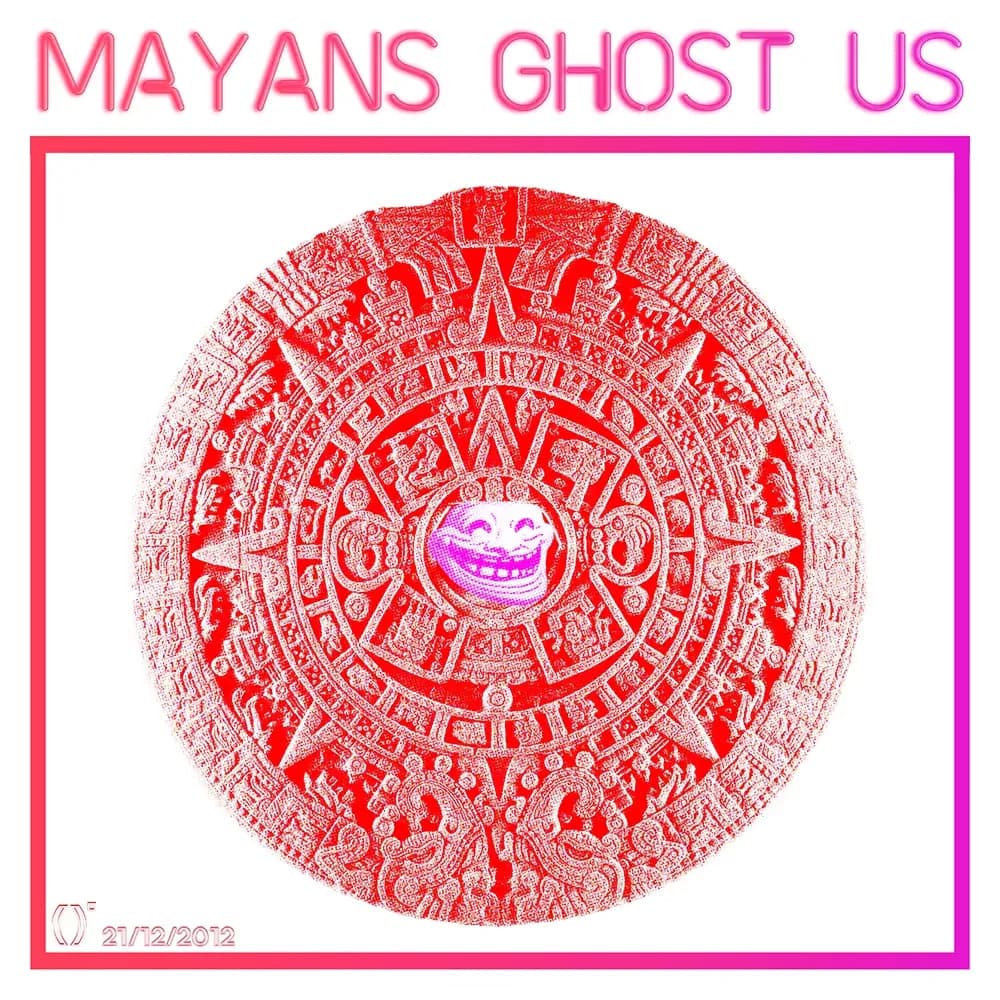
Catalogue exhibit #53
MAYANS GHOST US
The Moment
The image depicts the famous Mayan calendar with a "trollface" meme superimposed at its center, creating a commentary on humanity's persistent need to find meaning and predictability in complex systems. The Mayans developed this sophisticated calendar for agricultural and ceremonial purposes, but modern interpretations transformed it into an apocalyptic prophecy for December 21, 2012. The addition of the trollface meme cleverly highlights how our cognitive biases, particularly our tendency to see patterns where none exist, can lead to widespread misinterpretation of historical artifacts.
Look Closer
The title "MAYANS GHOST US" plays with modern internet slang while commenting on our psychological need for closure and explanation. Unlike the popular misconception, the Maya civilization didn't mysteriously vanish - their cities declined gradually due to various environmental and social factors, while their descendants continue to live in Central America today. The artwork highlights how humans often prefer dramatic, singular explanations (like apocalyptic predictions) over complex, multifaceted realities. This connects to our evolutionary tendency to seek patterns and create narratives as a way to make sense of an unpredictable world - a cognitive trait that helped our ancestors survive but can also lead to misguided beliefs and predictions. The piece ultimately serves as a mirror to our own psychological tendencies to create and believe in grand narratives, even when they're based on misunderstandings of historical evidence.
The research library
Why moments like this hold value → The Science